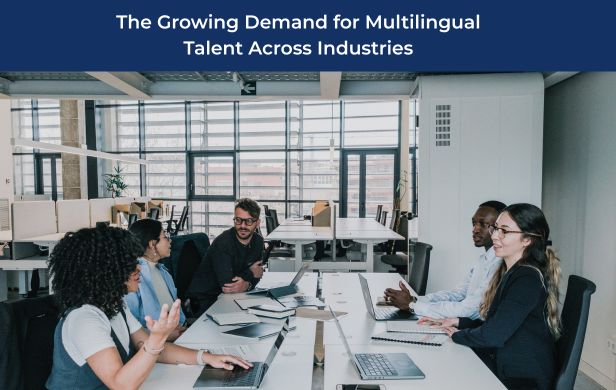
The Growing Demand for Multilingual Talent Across Industries
Have you ever tried to explain something important to someone who does not understand your language? Even a simple conversation can become difficult to handle. Today, businesses need multilingual professionals for much more than translation. Whether managing international suppliers, negotiating commercial contracts, supporting engineering projects, interpreting during business meetings, or coordinating global supply chains, organizations depend on professionals who combine advanced language skills with industry expertise. As global operations become more interconnected, recruiting qualified language experts has become essential for business success.
Multilingual professionals remain valuable assets to organizations across industries. They help businesses understand local cultures, communicate naturally with customers, and build trust in international markets. As companies continue to expand globally, recruiting language experts has become an essential part of building successful international teams.
In this blog, we’ll explore why multilingual talent is in such high demand, the benefits they bring to businesses, the hiring challenges companies face, and how organizations are finding the right language experts for long-term success.
Why Multilingual Talent Is in High Demand
Multilingual professionals now support critical business operations across procurement, engineering, manufacturing, legal services, healthcare, finance, vendor management, and international sales. Organizations need professionals who speak the language and understand industry terminology, technical documentation, commercial negotiations, and regional business practices.
Companies can now hire qualified workers from anywhere due to remote working options. Employees from various nations who speak different languages are frequently part of global teams. Multilingual employees help to bridge communication gaps, improve collaboration, and reduce misunderstanding among international teams.
Benefits of Hiring Multilingual Talent for Businesses
Hiring multilingual professionals creates opportunities for business growth, stronger customer engagement, and improved operational efficiency.
Improved Cross-Border Negotiations
Language experts help businesses negotiate contracts, discuss pricing, resolve disputes, and build long-term relationships with international suppliers and customers.
Better Vendor & Supply Chain Management
Manufacturers and import-export companies work with suppliers worldwide. Multilingual professionals help coordinate procurement, production schedules, quality discussions, logistics, and vendor communications seamlessly.
Support for Technical & Engineering Projects
Engineering companies often collaborate with foreign teams, equipment manufacturers, and technical consultants or serve clients across continents. Language experts ensure specifications, manuals, project discussions, and technical documentation are communicated accurately.
Legal & Commercial Accuracy
Contracts, compliance documents, regulatory discussions, and commercial agreements require precise communication. Language professionals help reduce misunderstanding that could result in legal or financial risks.
Challenges Companies Face in Language Expert Recruitment
Although the demand for multilingual professionals continues to grow, finding the right candidates is not always easy.
Shortage of Qualified Professionals
Some languages are widely common, while others have a limited talent pool of experienced professionals. Businesses frequently struggle to find experts who possess both advanced language skills and industry-specific knowledge.
This challenge becomes even greater for specialized fields such as healthcare, engineering, finance, and technical support.
Finding Professionals with Industry Expertise
Many candidates possess excellent language skills but lack practical knowledge of industries such as engineering, supply chain, manufacturing, healthcare, finance, legal services, or procurement. Businesses increasingly seek professionals who can confidently communicate using industry-specific terminology while understanding operational workflows.
Communication Skills and Cultural Adaptability
Successful communication requires far more than vocabulary and grammar. Language professionals frequently communicate with customers, business partners, and internal teams.
Hiring Talent Across Different Regions
Managing recruitment across multiple countries requires careful planning and expertise to ensure a smooth hiring process, as it offers additional complexities, including time zone differences, employment regulations, work permits, payroll requirements, and local hiring practices.
How Companies Are Overcoming Multilingual Hiring Challenges
To meet the growing demand for multilingual talent, businesses are adopting smarter recruitment strategies.
Partnering with Language Recruitment Agencies
Many organizations now work with recruitment agencies that specialize in sourcing multilingual professionals. These agencies have access to established talent networks and understand the various requirements of language-focused roles.
Recruitment Strategies
Employers increasingly assess both language proficiency and domain expertise. Many recruitment processes now include technical interviews, business scenario assessments, and industry-specific evaluations to ensure candidates can perform effectively in real-world environments.
Building Multilingual Talent Pipelines
Most of the companies do not wait for vacancies to appear. Instead, they partner with universities, language institutes, professional associations, and diaspora communities to create long-term talent pipelines.
Incentives for Language Experts
Professionals who speak less common language combinations are often in high demand.
To attract and retain these specialists, companies are offering competitive salaries, flexible work arrangements, career development opportunities, relocation assistance, and attractive benefits to make their organizations more attractive to top talent.
Why Multilingual Talent Will Continue to Grow
The demand for multilingual professionals is expected to increase as businesses continue to expand into global markets.
Globalization is bringing countries closer together, and cross-border communication is becoming a daily business necessity rather than assistance in occasional meetings.
Although AI can assist with routine translation tasks, businesses still rely on human language experts for negotiations, interpretation, legal discussions, supplier management, engineering collaboration, commercial decision-making, and culturally sensitive business interactions where accuracy and judgment are essential.
Also, customers expect personalized experiences in their own language. Businesses that invest in localization and culturally relevant communication continue to outperform competitors that depend completely on automated translations.
Final Thoughts
Building a global workforce requires professionals who understand culture, communication, and context.
At Language Services Bureau (LSB), we recruit highly qualified language professionals who combine multilingual communication skills with expertise in domains like engineering, manufacturing, supply chain, procurement, vendor management, legal services, commercial negotiations, healthcare, marketing, sales, or business development. We help organizations build global teams capable of supporting complex business operations, not just translation and localization.
Ready to strengthen your multilingual talent workforce?
Contact us today!
FAQs
1. Why is multilingual talent becoming more important for businesses?
Multilingual professionals help businesses communicate with global customers as vendors, support international teams, localize content, and build stronger relationships across different markets.
2. What are the benefits of hiring qualified language experts?
Qualified language experts improve customer communication, support global expansion, enhance collaboration, strengthen brand reputation, and help businesses overcome language and cultural barriers.
3. What challenges do companies face when recruiting language experts?
Organizations often struggle with a limited talent pool, assessing language proficiency, evaluating cultural fit, and managing recruitment across multiple countries and regions.
4. How can businesses improve language expert recruitment?
Companies can partner with specialized language recruitment agencies and offer competitive benefits to attract skilled multilingual professionals.
5. Can AI replace multilingual professionals?
No. While AI translation tools can assist with basic communication, they cannot fully understand cultural context, industry-specific terminology, tone, or complex conversations.