Why Cultural Intelligence Matters in Global Capability Centers
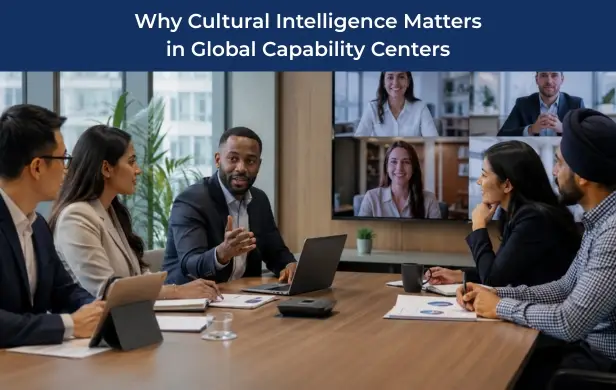
If you’ve ever sat through a meeting where everyone spoke English but communication felt incomplete, you’ve experienced a cultural intelligence gap firsthand. In Global Capability Centers (GCC), this happens more often than most leaders care to admit. GCCs are, by definition, cross-cultural environments. Your teams in Pune or Bengaluru are working daily with colleagues, clients, and stakeholders from Germany, Japan, the US, South Korea, and beyond.
And while most GCCs invest heavily in technical skills and process alignment, cultural intelligence, which is the ability to understand, adapt to, and work effectively across cultural differences, often gets left out of the conversation entirely. That’s a costly oversight.
What Is Cultural Intelligence and Why Should GCCs Care?
Cultural intelligence (CQ) is more than just knowing that Germans prefer direct communication or that Japanese business culture values hierarchy. It’s a deeper competency, such as the ability to read cultural cues, adjust your communication style, and build genuine trust across cultural boundaries.
For GCCs, this matters at every level. An engineer collaborating with an OEM team in Stuttgart needs to understand not just the language but the working culture. An HR manager rolling out a global policy needs to recognize how differently that policy might be received in India versus France. A project manager coordinating with teams across five countries needs to navigate cultural expectations around deadlines, feedback, and decision-making simultaneously.
When cultural intelligence is missing, it results in missed deadlines, strained relationships, and business outcomes that fall short of their potential.
Where Cultural Gaps Show Up in GCC Operations
1. Manufacturing and Heavy Engineering GCCs
In such large organisational structures, cultural gaps often surface during technical collaborations. When Indian engineers work alongside counterparts from Germany or Japan — two cultures known for their precision, formal communication, and strict adherence to process — misalignments in working style can create friction that slows down projects significantly.
A German engineer who expects exhaustive documentation before proceeding may clash with a team that prefers a more flexible, iterative approach. A Japanese colleague who avoids saying “no” directly may be misread as agreeable when they’re actually raising a serious concern. Understanding these cultural nuances is an important necessity.
2. Automobile GCCs
Automobile GCCs working with global OEMs constantly face this challenge . Design reviews, homologation processes, supplier evaluations, and product launches all involve intensive communication. When your GCC is the bridge between a Japanese parent company and a European supply chain, cultural misreads at any point can delay an entire product program.
Cultural sensitisation workshops and language support together ensure that your teams are understanding intent, context, and expectation accurately.
3. IT and Business Services GCCs
For IT GCCs, cultural intelligence plays a critical role in client communication and project delivery. A team delivering software for a US-based financial firm needs to understand not just the technical requirements but the communication cadence, feedback culture, and business etiquette their client expects.
Without this, technically excellent work can land poorly.
The Link Between Language and Cultural Intelligence
Language and culture are inseparable. You cannot truly build cultural intelligence without engaging seriously with language, and this is where many GCCs underinvest.
When done well, corporate language training immerses employees in the cultural context of the language, how business is conducted, how disagreement is expressed, how relationships are built. An employee who learns Japanese is gaining a window into a way of thinking that makes them significantly more effective in cross-cultural collaboration.
Similarly, when content is localized rather than just translated, it reflects cultural awareness. An eLearning module adapted for a German audience doesn’t just use German words, but reflects German professional norms, learning preferences, and communication styles. That level of adaptation builds credibility and trust with global stakeholders.
How Cultural Intelligence Accelerates GCC Growth
GCCs with high cultural intelligence scale faster and more sustainably for a few key reasons.
- They build stronger relationships with parent companies. When a GCC team demonstrates genuine understanding of the parent company’s culture, communication improves, trust deepens, and the GCC is entrusted with higher-value work over time.
- They retain talent better. Employees who feel equipped to navigate cross-cultural environments are more confident, more engaged, and less likely to feel overwhelmed by the demands of a global role.
- They reduce costly miscommunications. In manufacturing and automobile GCCs especially, a misunderstanding in a technical review or a supplier negotiation can cascade into expensive rework, missed timelines, or damaged partnerships.
Building Cultural Intelligence in Your GCC
Here’s where to start:
- Corporate language training tailored to the languages your teams work with most, such as German, Japanese, French, Korean, and others.
- Cultural sensitisation programs for employees taking on new global responsibilities.
- Professional interpretation for high-stakes meetings and negotiations, ensuring nothing is lost in translation.
- Localization of internal communications and training content so that every employee, regardless of location, receives messages that feel relevant and respectful.
Partner With Language Services Bureau to Build a Culturally Intelligent GCC
Language Services Bureau has been helping India’s leading multinationals bridge language and cultural gaps since 1979. With deep expertise across major language combinations, corporate language training programs, and professional interpretation services, we give GCCs the tools they need to operate with confidence across cultures.
Whether your teams are collaborating with engineers in Tokyo, negotiating with suppliers in Munich, or onboarding talent for a French parent company, we ensure that language never stands in the way of your growth.
Ready to build a culturally intelligent GCC?
Get in touch with the Language Services Bureau today!
How is cultural intelligence different from simply knowing a foreign language?
Language is one component of cultural intelligence, but CQ also includes understanding unspoken norms, communication styles, and business etiquette that vary significantly across cultures.
How does poor cultural intelligence affect manufacturing GCCs specifically?
In manufacturing, cultural misreads during technical reviews or supplier negotiations can lead to costly rework, production delays, and damaged long-term partnerships.
Can corporate language training really improve cross-cultural collaboration?
Yes, well-designed language training goes beyond grammar to build cultural awareness, helping employees communicate with greater confidence and sensitivity in global roles.
Which languages are most valuable for GCC employees to learn in India?
German, Japanese, French, Korean, and Mandarin are particularly valuable given the volume of GCCs in India with parent companies in these regions.
How does localization differ from translation in the context of internal GCC communications?
Localization adapts content to reflect cultural values and preferences, while translation only converts language, making localized communications more effective and credible with global audiences.
Language is one component of cultural intelligence, but CQ also includes understanding unspoken norms, communication styles, and business etiquette that vary significantly across cultures.
In manufacturing, cultural misreads during technical reviews or supplier negotiations can lead to costly rework, production delays, and damaged long-term partnerships.
Yes, well-designed language training goes beyond grammar to build cultural awareness, helping employees communicate with greater confidence and sensitivity in global roles.
German, Japanese, French, Korean, and Mandarin are particularly valuable given the volume of GCCs in India with parent companies in these regions.
Localization adapts content to reflect cultural values and preferences, while translation only converts language, making localized communications more effective and credible with global audiences.