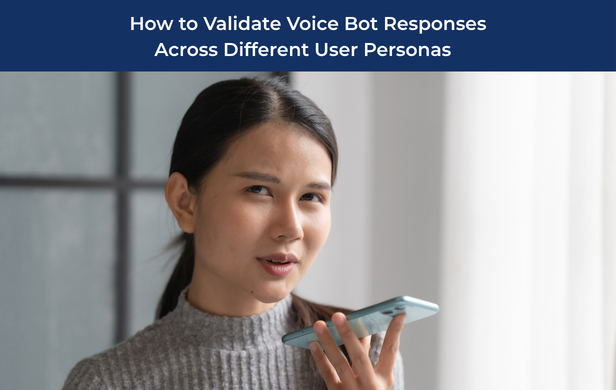
How to Validate Voice Bot Responses Across Different User Personas
A voice bot can understand most of what a customer says, but the user experience may be poor nonetheless.
A customer may speak quickly, use a regional accent, switch between languages, interrupt the bot, or simply phrase a request differently from what the system expects. The bot might recognize the words correctly, but completely miss what the customer actually means.
Consider three customers trying to reschedule an appointment. One of them says, “I want to reschedule my appointment.” Another one asks, “Can I move my appointment to Friday?” A third customer simply says, “Change my appointment.”
The intent is the same, but the communication is not.
Thus, using a few common questions to test a voice bot is insufficient. Companies must understand how the bot functions when interacting with various kinds of users.
Hence, persona-based voice bot validation is important.
Why Voice Bot Validation Matters
Voice bots are becoming part of everyday customer interactions across banking, healthcare, travel, retail, e-commerce, and other industries. Once implemented, they can answer questions quickly, reduce waiting times, and make customer support more accessible.
But a small misunderstanding can quickly turn a simple conversation into a frustrating one.
Effective voice bot validation checks whether the system can:
- Understand what the customer actually wants
- Identify the correct intent
- Provide accurate and relevant information
- Maintain context throughout the conversation
- Handle different accents and communication styles
- Respond in natural sounding language and appropriately
- Recognise frustration or confusion
- Know when to transfer the conversation to a human
The best question to ask is, “Does it sound right to the people who will actually use it?” legally binding, accuracy and clarity were critical.
What Is Voice Bot Response Validation?
Voice bot response validation is the process of checking whether a voice bot correctly understands a user’s speech and responds in a useful, accurate, and appropriate way.
Think of voice bot performance in three layers:
- Speech recognition: Did the bot hear the user correctly?
- Intent understanding: Did it understand what the user meant?
- Response quality: Did it provide the right answer or take the right action?
A bot can succeed at the first step but fail at the next two.
Language validation also checks whether the bot can handle follow-up questions, retain context, recover from misunderstanding, and know when a human is required.
compliance risks during the launch phase.
Why User Personas Matter in Voice Bot Testing
People don’t communicate with technology the same way they communicate with humans. Persona-based testing recreates real-world scenarios before they become real customer problems.
Instead of testing only the following:
‘I want to cancel my booking.’
Teams can test variations such as the following:
- Market credibility
- ‘Can you cancel my booking?’
- ‘I don’t want this booking anymore.’
- ‘Cancel it.’
- ‘Actually, I need to cancel the booking I made yesterday.’
The objective is to determine whether the bot understands intent and a non-English language well, not just matches specific phrases.
What Should You Validate in a Voice Bot Response?
Intent Accuracy
Did the bot understand what the user actually wanted?
Response Accuracy
Did it provide the correct information or complete the requested action?
Context Retention
Can the bot remember earlier parts of the conversation when answering a follow-up question?
Conversational Sensitivity
Does the response match the user’s situation? A frustrated customer should not receive the same tone as someone casually asking for information.
Natural Conversation
Does the interaction feel conversational, or does it sound like the user is being pushed through a rigid script in an artificial sounding language?
Language and Pronunciation
Can the bot understand and respond appropriately across relevant languages, accents, and regional speech patterns? Does the language sound natural, or is it some weird phraseology?
Recovery From Misunderstandings
What happens when the bot gets something wrong? A good system should make clarification easy, rather than continuously giving the wrong answer.
Transfer to a human
Some conversations should not remain with a bot.
If the user is repeatedly misunderstood, the request is unusually complex, or the situation requires human judgment, the bot should transfer the conversation to a human agent.
How Language and Cultural Context Affect Voice Bot Responses
There is another layer that businesses should not overlook: language and culture.
A response can be grammatically correct but feel inappropriate to the person hearing it. People from different cultures may have different expectations around politeness, formality, directness, disagreement, and even how they express frustration.
Local expressions can also carry meanings that an exact translation may miss. This is why multilingual voice testing should ask whether the meaning, tone, intent, and context have been preserved after localization.
For example, a phrase that sounds natural in one market may sound overly formal, blunt, or unfamiliar in another market and surely, in a different language. English phrases are syntax are becoming too common and weird sounding in translated languages, where the same syntax sounds foreign, distant, and confusing sometimes!
Language and cultural intelligence play an important role in creating voice experiences that feel natural to a global audience. This is where expertise in translation, interpretation, and localization becomes valuable. Language professionals can identify linguistic and cultural problems that automated testing may overlook.
For organizations building multilingual customer experiences, human testing should be part of voice bot validation from the beginning, not added after the technology has been deployed, since training materials also need to be checked for correct language.
Final Thoughts
Voice bot performance cannot be judged by testing a handful of standard conversations.
Real users bring different accents, communication styles, languages, emotions, expectations, and levels of familiarity with technology. These differences can expose weaknesses that conventional testing may never find.
Language and cultural problems can mainly affect how users interact with voice technology. Language Services Bureau (LSB) has been helping organizations to fill language and cultural gaps since 1979, bringing that same expertise to multilingual communication, localization, interpretation, and language requirements for voice-driven customer experiences.
What is voice bot response validation?
Voice bot response validation is the process of verifying that a voice bot correctly understands users and provides accurate, relevant, and appropriate responses in various natural languages.
Why should voice bots be tested across different user personas?
Since users communicate differently, accents, speaking styles, languages, emotional states, and levels of technical familiarity can all affect how a voice bot understands and responds to a request.
What user personas should be included in voice bot testing?
Businesses should consider first-time users, tech-savvy users, frustrated customers, users with different accents and speech patterns, and multilingual or code-switching users.
How do language and cultural differences affect voice bot performance?
They can influence pronunciation, intent, tone, politeness, expressions, and users’ expectations of how a system should respond. A grammatically correct response may feel unnatural if the cultural context is missing.
Can voice bot testing be automated?
Yes. Automated testing can efficiently check large numbers of conversations, but human evaluation remains important for assessing tone, cultural appropriateness, context, and overall conversation quality, at least at the start of planning and deployment.