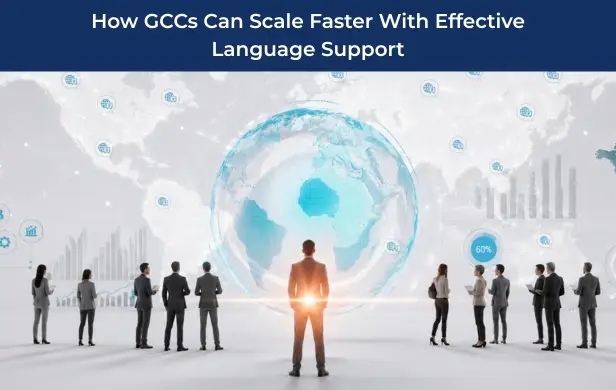
How Engineering GCCs Can Scale Faster With Effective Language Support
Global Capability Centers (GCCs) in India are growing at an impressive pace. With over 1,700 GCCs already operating in the country and numbers growing every year, the competition to scale efficiently has never been more intense. However, language often gets overlooked while scaling.
When teams are collaborating across Germany, Japan, Brazil, and the US simultaneously, language barriers create compliance risks, miscommunication, and missed opportunities. Effective language support is then a core operational requirement.
Why Language Barriers Are a Hidden Growth Bottleneck
Most GCC leaders focus on talent, technology, and processes when planning scale. But language gaps chip away at productivity in ways that are hard to measure until they turn into serious problems.
This is especially true for GCCs operating in manufacturing, heavy engineering, and the automobile sector. These industries rely heavily on highly technical documentation, such as design specifications, CAD drawing annotations, assembly manuals, standards, specifications, quality control protocols, and safety data sheets. When this content arrives from a parent company in Germany, Japan, or Italy and needs to be actioned by teams in India, a minor translation error can halt a production line or trigger costly rework.
For automobile GCCs managing R&D, powertrain engineering, or supply chain functions, multilingual communication directly impacts product safety and regulatory compliance across markets.
How Language Support Directly Enables GCC Scaling
1. Faster Onboarding Across Geographies
When a GCC expands operations or takes on new functions from a parent company abroad, onboarding materials, process manuals, and training content often arrive in the parent company’s language. For heavy engineering and manufacturing GCCs, these can include but are not limited to technical content, such as machine operating procedures, EHS (Environment, Health & Safety) guidelines, and plant management protocols, that need to be accurately translated before teams can begin work.
Professional translation services ensure nothing gets lost in translation, whether it’s a torque specification, a welding procedure standard, or an HR compliance policy.
2. Seamless Communication With Global Stakeholders
GCCs serve as strategic hubs for their parent organizations. That means regular interaction with teams, clients, and vendors from across the world. For automobile and heavy engineering GCCs, this often includes on-site visits from foreign technicians, joint engineering reviews, and supplier negotiations with counterparts from Germany, Japan, South Korea, or France.
Interpretation services, both in-person and remote, make these high-stakes interactions smooth and productive. Whether it’s a plant walkthrough with Japanese engineers or a contract discussion with a French Tier-1 supplier, having a professional interpreter in the room ensures nothing critical gets misunderstood.
3. Localized Training and eLearning at Scale
As GCCs grow their workforce, delivering consistent, high-quality training becomes a challenge, especially when employees speak different languages. For manufacturing GCCs, this is particularly relevant for shop floor safety training, machine operation, and quality management systems like IATF 16949 (the automotive quality standard).
eLearning localization allows GCCs to adapt training modules for regional audiences without rebuilding content from scratch, ensuring that every worker, regardless of their language background, receives accurate and culturally appropriate training.
4. Accurate Technical and Legal Documentation
GCCs in heavy engineering and automotive sectors routinely handle patents, technical drawings, homologation documents, and supplier contracts that require precise translation. A mistranslation in a technical specification or a type-approval document can lead to serious compliance failures or expensive engineering changes.
Certified translation services ensure these documents are translated accurately and carry the necessary endorsements for official use, e.g. for government submissions, international audits, or cross-border legal compliance.
5. Stronger Vendor and Partner Relationships
Scaling a GCC also means building a robust ecosystem of local and international vendors, partners, and service providers. In the automobile and manufacturing space, this involves coordinating with OEMs, Tier-1 suppliers, and technology partners spread across multiple continents.
When communication flows clearly, without language friction, partnerships are built on trust and precision. Commercial translation services help GCCs manage everything from vendor agreements and technical proposals to product documentation for global markets.
The Role of Localization in Long-Term GCC Growth
Scaling is all about adapting intelligently to new markets and contexts. For automobile GCCs developing connected vehicle platforms, ADAS systems, or EV technology, software and app localization ensures that the end product resonates with users across global markets.
Similarly, manufacturing GCCs deploying enterprise software, IoT platforms, or digital twin solutions need software localization to ensure seamless adoption across regions. Localization bridges the gap between what your engineering teams build and what end users across the world actually experience.
What to Look for in a Language Partner for Your GCC
- Industry Expertise: Your language partner should understand your domain – e.g. automotive engineering, industrial manufacturing, pharma, or IT.
- Speed and Reliability: GCCs operate on tight timelines. You need a provider that delivers on time, every time, without sacrificing quality.
- Certified Translations: For regulatory and legal documents, certification matters.
- Wide Language Coverage: Look for a provider that covers both Indian and international languages under one roof.
- Confidentiality: Given the sensitive nature of GCC operations, data security and confidentiality are non-negotiable.
The Value of Language Training for GCC Teams
Language training is an often-overlooked capability that delivers long-term value for engineering GCCs. Foreign language training in German, Japanese, French, or Korean, helps your engineers and procurement teams engage directly with global counterparts, while corporate English communication training sharpens business writing, presentation skills, and professional vocabulary for high-stakes global interactions.
Together, they reduce dependency on intermediaries and position your GCC as a truly world-class operation.
Scale Smarter With Language Services Bureau
Language Services Bureau has been a trusted language partner for leading multinational companies in Pune and across India since 1979. With 46+ years of experience, ISO 9001-2015 certification from TUV India, and expertise across 120+ language combinations, Language Services Bureau is uniquely positioned to support GCCs at every stage of their growth journey.
From technical translation and certified document translation to eLearning localization, interpretation services, and corporate language training, we offer everything your GCC needs to communicate clearly, comply confidently, and scale faster.
Language barriers shouldn’t be the reason your GCC scales slower than it should.
Reach out to Language Services Bureau today!
How do language services help GCCs manage compliance across multiple countries?
Certified translation ensures regulatory filings, legal documents, and technical submissions are accurately translated and officially endorsed for each country’s requirements.
What is the difference between translation and localization, and which does a GCC need?
GCCs need both translation for documents and communication, and localization to culturally adapt software, apps, training content, and customer-facing platforms.
Can interpretation services be provided remotely for GCC teams spread across locations?
Yes, online interpretation services connect professional interpreters to virtual meetings and conferences across time zones, with no physical presence required.
How quickly can a language service provider turn around urgent translation requests?
Most urgent requests for standard documents can be fulfilled within 24 to 48 hours by an experienced provider, depending on volume and language pair.
Is corporate language training useful for GCC employees in technical roles?
Yes, engineers and technical staff who learn their parent company’s language collaborate more effectively on cross-border projects and reduce dependency on translators for day-to-day communication.