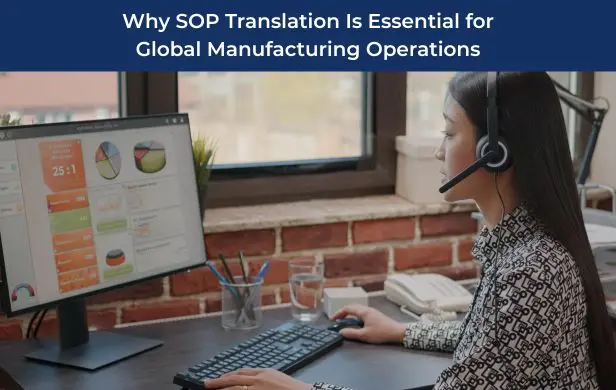
Why SOP Translation Is Essential for Global Manufacturing Operations
In global manufacturing environments, consistency is everything. Be it for an automotive assembly line or a heavy engineering facility, operations depend on clearly defined processes that ensure quality, safety, and efficiency. These processes are captured in Standard Operating Procedures (SOPs).
However, as manufacturing operations expand across countries, languages become a critical factor. SOPs that are not accurately translated can lead to misunderstanding, operational errors, and compliance risks. This is where SOP translation becomes essential.
What are SOPs in Manufacturing?
Standard Operating Procedures (SOPs) are detailed, step-by-step instructions that guide workers in performing tasks correctly and safely. In the automotive and manufacturing industries, SOPs may include:
- Equipment operation instructions
- Assembly line procedures
- Safety protocols
- Maintenance guidelines
- Quality control processes
These documents are operational standards that directly impact production outcomes.
The Challenge of Multilingual Manufacturing Environments
- Multinational workforces
- International production units
- Local vendors and partners
- Region-specific compliance requirements
Why SOP Translation Matters
-
Ensures Operational Consistency
Manufacturing processes must be executed uniformly across all locations. SOP translation ensures that every team, regardless of location or language, follows the same instructions in the same way. This is particularly critical in industries like automotive manufacturing, where even minor deviations can affect product quality. -
Improves Workplace Safety
Safety instructions are a core component of SOPs. Misinterpreting a safety step can result in accidents, equipment damage, or regulatory violations. Accurate translation ensures that all employees clearly understand safety protocols, reducing workplace risks. -
Supports Regulatory Compliance
Manufacturing companies must comply with local and international standards. Regulatory bodies often require documentation to be available in the local language. Proper SOP translation helps organisations meet these requirements and avoid compliance-related delays or penalties. -
Enhances Workforce Efficiency
When employees understand instructions clearly in their native language, they can perform tasks more efficiently. This reduces:- Training time
- Errors and rework
- Dependency on supervisors for clarification
-
Strengthens Global Collaboration
Manufacturing projects often involve coordination between global teams, vendors, and stakeholders. Translated SOPs ensure that all parties operate with a shared understanding of processes and expectations.
Why Technical Expertise Is Critical in SOP Translation
- Understanding of engineering and manufacturing terminology
- Familiarity with equipment, processes, and safety standards
- Ability to maintain clarity and precision in instructions
- Consistency across documents and versions
The Role of Format and Structure
- Tables and checklists
- Flowcharts and diagrams
- Numbered instructions
- Technical annotations
SOP Translation in Automotive and Manufacturing
- Production line efficiency
- Product quality and consistency
- Worker safety
- Compliance with international standards
Final Thoughts
Global manufacturing operations rely on precision, consistency, and clarity. SOPs are the backbone of these operations, and their effectiveness depends on how well they are understood across teams.
SOP translation ensures that processes are correctly executed, regardless of language or location. It reduces risk, improves efficiency, and supports seamless global operations.
At Language Services Bureau (LSB), we have worked in technical translations for the automotive and manufacturing sectors for the last 4.5 decades and more. Our team ensures that your SOPs are translated with accuracy, consistency, and industry-specific expertise.
If your operations span multiple regions, ensure your processes do too.
Partner with LSB for precise SOP translation that supports global manufacturing success.
Ready to scale your operations globally with confidence? Talk to our translation experts today.
How is SOP translation different from general document translation?
SOP translation requires technical accuracy and clarity, as the content directly impacts operations, safety, and compliance.
Can SOP translation support training for new employees?
Yes. Translated SOPs make onboarding easier by helping employees understand processes in their preferred language.
What formats are typically handled in SOP translation?
SOPs may include PDFs, Word documents, Excel sheets, and diagram-based formats like Visio that need to be preserved during translation.
Is SOP translation useful for vendor and supplier communication?
Yes. It ensures that external partners follow the same operational standards as internal teams.
How does SOP translation support scalability in manufacturing?
It enables companies to replicate processes across new locations without compromising quality or consistency.