What Is Machine Translation Post-Editing (MTPE) and When Does It Make Sense?| Language Services Bureau
As businesses expand across borders, the demand for multilingual content has grown rapidly. Websites, product documentation, training materials, support content, and internal communications now need to be available in multiple languages, often within tight timelines. To meet this demand, many organisations turn to machine translation for speed and cost efficiency.
However, machine translation alone is rarely sufficient for professional use. This is where Machine Translation Post-Editing (MTPE) comes in.
MTPE combines the speed of machine translation with the accuracy and judgment of human linguists. It offers a practical middle ground between raw machine output and full human translation. While MTPE can be effective, it is not suitable for every type of content. Understanding what MTPE is, how it works, and when it makes sense is key to using it successfully.
What Is Machine Translation Post-Editing (MTPE)?
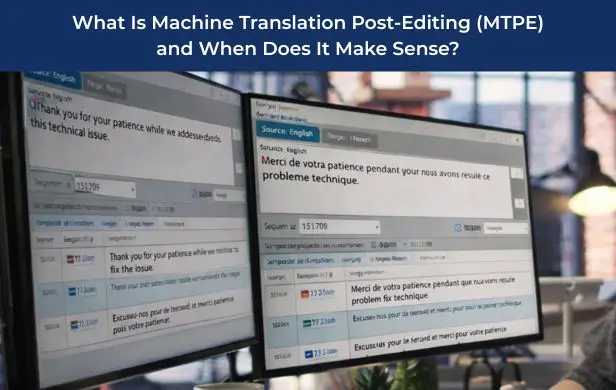
MTPE is the process of reviewing, correcting, and refining machine-translated text by a professional human linguist. Instead of translating content from scratch, the linguist edits the machine output to ensure it meets defined quality standards.
The goal of MTPE is to ensure accuracy, clarity, and usability. The linguist focuses on fixing errors that machines commonly make, such as incorrect terminology, awkward phrasing, mistranslations, missing context, or inconsistent language.
Why Machine Translation Alone Isn’t Enough
- Incorrect or inconsistent terminology
- Literal translations that miss the intended meaning
- Errors in tone or register
- Poor handling of complex sentence structures
- Lack of cultural or industry context
- Loss of formatting
- Errors in numerical and alphanumerical designs
When Does MTPE Make Sense?
- 1. High-Volume Content
- Knowledge bases
- FAQs
- Help articles
- 2. Time-Sensitive Projects
- 3. Content with Repetitive Language
- 4. Budget-Conscious Multilingual Scaling
When MTPE Does NOT Make Sense
- Legal contracts and agreements
- Regulatory submissions
- Certified translations
- Patient-facing medical and pharma content
- Marketing or brand-driven copy
The Importance of Domain Expertise in MTPE
- Strong language skills
- Deep understanding of the subject matter
- Familiarity with industry terminology
How LSB Approaches MTPE
- Evaluating whether MTPE is appropriate for the content
- Defining quality expectations upfront
- Using terminology databases and translation memory
- Selecting the right MT/AI tool based on the language pair and domain
- Assigning linguists with domain expertise
- Performing consistency and accuracy checks
MTPE as Part of a Broader Translation Strategy
- Full human translation for high-risk content
- MTPE for high-volume or time-sensitive materials
- Review and QA processes for quality control
Final Thoughts
Machine Translation Post-Editing is neither a replacement for human translation nor a simple proofreading task. When used appropriately, it is a powerful tool that combines automation with human expertise to support multilingual growth at scale.
The key to successful MTPE lies in knowing when it makes sense, setting the right quality expectations, and working with experienced linguists. Used carelessly, it can introduce risk. Used strategically, it delivers speed, efficiency, and control.
If you’re exploring MTPE and want to understand whether it’s the right fit for your content, Language Services Bureau can advise you professionally!
Scale your multilingual content with confidence. Speak to our MTPE experts today at +91 8237060559
Does MTPE follow the same quality standards as human translation?
No. MTPE focuses on accuracy and usability, not stylistic refinement.
Can MTPE be done on content already machine-translated?
Yes, as long as the output is editable and of usable quality.
How do you know if MTPE is cost-effective?
It works best for high-volume, repetitive content with low regulatory risk and is charged less than human translation.
Is MTPE suitable for projects with multiple languages?
Yes, when supported by strong terminology control and QA processes.
What if the machine translation quality is poor?
In such cases, full human translation is the better option.