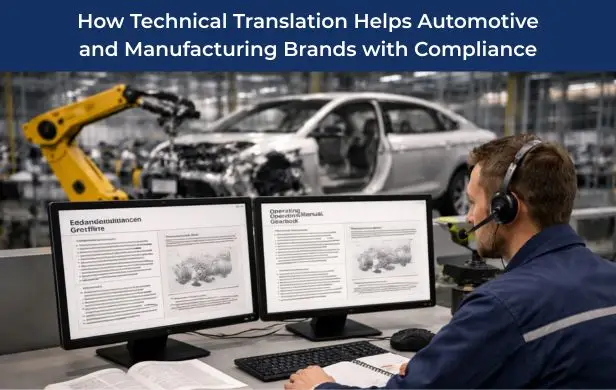
How Technical Translation Helps Automotive and Manufacturing Brands with Compliance
In the automotive and manufacturing industries, compliance is a critical component of safety, quality, and operational continuity. From installation manuals and safety instructions to product specifications and regulatory documentation, every piece of information must be accurate, clear, and aligned with local standards.
As companies expand across global markets, ensuring that this information is correctly translated becomes essential. This is where technical translation plays a key role in supporting compliance across regions.
The Role of Documentation in Compliance
- User manuals and installation guides
- Safety instructions and warning labels
- Technical specifications and data sheets
- Quality assurance and inspection reports
- Regulatory and certification documents
Why Technical Translation Is Different
- Understanding of engineering concepts and terminology
- Consistency in technical vocabulary
- Familiarity with industry standards and compliance requirements
- Precision in conveying instructions and specifications
- Use of simple language
Ensuring Regulatory Alignment Across Markets
- Safety standards may vary across regions
- Labeling and documentation requirements differ by country
- Certification processes often require local-language documentation
Reducing Risk and Liability
- Improper installation or usage of machinery
- Workplace safety risks
- Product recalls or compliance failures
- Legal liabilities and financial penalties
Supporting Global Operations
- Maintain uniform terminology across languages
- Ensure clarity for international teams and partners
- Enable seamless communication between headquarters and local operations
The Importance of Format and Structure
Compliance documentation often includes structured formats such as:
- Engineering drawings
- Tables and technical charts
- Safety symbols and annotations
Technical translation ensures that not only the content but also the format and structure remain intact, preserving usability and compliance.
Why Human Expertise Matters
- Accurate interpretation of technical content
- Consistent use of industry-specific terminology
- Alignment with regulatory expectations
Final Thoughts
For automotive and manufacturing brands, compliance is directly linked to how well technical information is communicated. As companies expand globally, technical translation is a critical enabler of regulatory alignment, safety, and operational efficiency.
Investing in professional technical translation ensures that every instruction, specification, and requirement is understood exactly as intended, across every market.
At Language Services Bureau (LSB), we specialise in ISO-certified technical translation for automotive, engineering, and manufacturing industries, ensuring accuracy, consistency, and compliance across global markets.
If your organisation requires reliable technical translation for compliance-critical documentation, partner with LSB to ensure precision at every step.
Get in touch with us today.
What types of documents require technical translation for compliance?
Documents such as safety manuals, product labels, test reports, and certification paperwork often require accurate technical translation for compliance.
Can technical translation help during product audits or inspections?
Yes. Clear and correctly translated documentation helps auditors understand processes and ensures smoother inspection outcomes.
Is multilingual documentation mandatory for all markets?
In many countries, regulations require documentation to be provided in the local language, especially for safety and operational materials.
How does technical translation support supplier and partner communication?
It ensures that all stakeholders, including suppliers and distributors, clearly understand specifications, reducing errors and misalignment.
What role does consistency play in compliance translation?
Consistent terminology across documents helps avoid confusion, ensures accuracy, and supports regulatory acceptance.