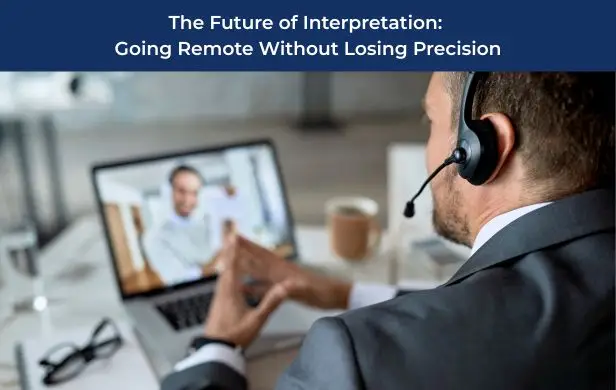
Remote interpretation has transformed the way organisations communicate in a multilingual world. The combination of digital adoption, global operations and rising demand for specialised language expertise pushed interpreting beyond traditional in-person formats. Yet precision remains the benchmark, whether interpreting takes place onsite or online. Understanding how remote interpretation preserves accuracy is key to preparing for the future of global communication.
The rise of remote interpretation didn’t happen overnight. Several factors contributed to its widespread adoption:
Meetings, consultations, hearings and conferences moved online almost overnight. As platforms like Zoom became central to daily operations, interpreters could be integrated directly into virtual meetings, with participants selecting language channels to access the discussion in their preferred language.
This ensured continuity of communication even when in-person interpretation was not possible.
Teams are no longer located in one geography. Multinational companies work across time zones, languages and cultures. Remote interpretation enables seamless collaboration regardless of location.
Telemedicine, virtual clinical trials and multinational pharma collaborations demand immediate language support. Remote interpretation provides medical-grade accuracy without delays.
High-quality audio/video platforms, encrypted communication channels and dedicated interpretation tools have made remote delivery reliable and secure.
Remote interpretation reduces logistical challenges by eliminating travel, scheduling conflicts and additional overhead. Teams can connect with qualified interpreters instantly, making multilingual communication faster and more efficient.
This approach has proven especially valuable in time-sensitive business scenarios. Recently, LSB supported an Indian automobile company by providing on-call interpreters for multiple interviews conducted over two weeks for the African market. With Portuguese and French interpreters joining the interviews remotely, the company was able to conduct discussions smoothly without delays.
The ability to bring in language expertise on demand proved to be a significant operational advantage.
As digital adoption grows, industries naturally prefer solutions that integrate easily with their virtual workflows.
Remote interpretation fits seamlessly into this ecosystem.
Despite differences in delivery format, the core principles of interpretation remain unchanged: fidelity, accuracy, speed and cultural awareness. High-quality remote interpretation replicates the strengths of in-person interactions through:
One of the biggest advantages is access. Organisations can connect with interpreters trained in law, medicine, finance, pharma or technical domains within minutes.
In-person interpretation limits organisations to interpreters who can be physically present. Remote interpretation opens access to specialists anywhere in the world, often essential in rare or niche languages.
Remote interpretation thrives on preparation. Interpreters receive context documents, glossaries, terminology lists and event agendas in advance, enabling them to deliver precise results.
Modern remote platforms use encryption, secure logins and controlled access, especially important for healthcare, pharma and legal settings where confidentiality is critical.
From one-on-one consultations to multi-speaker conferences, remote interpretation systems can scale effortlessly.
One of the most common questions remains: Does remote interpretation compromise accuracy?
The answer is no, provided it is conducted by trained professional interpreters with domain knowledge.
Here’s why precision remains intact:
Professional interpreters undergo training specifically for virtual environments. They learn how to manage multiple speakers, pick up on tone shifts and maintain accuracy even with fast-paced dialogue.
In pharma, legal proceedings or business negotiations, interpreters must understand the subject matter deeply. Remote delivery does not diminish this requirement.
Advanced platforms reduce noise, enhance clarity and create near in-person audio environments, helping interpreters capture every detail.
Like in person, remote interpretation sessions are most effective when interpreters receive materials in advance. This allows them to prepare terminology, especially in highly technical fields like medicine and engineering, and read up on the agenda and main content, thus being able to set the context.
Some interpreters actually perform better remotely because they can access digital terminology tools and resources instantly.
The mode of delivery does not decide the quality, the interpreter’s skill does.
Remote interpretation has already transformed several sectors:
Patients increasingly access doctors through telehealth. Remote interpretation supports multilingual consultations, diagnostics, and follow-ups, especially for communities with limited English proficiency.
Clinical trials often span multiple countries. Remote interpretation ensures investigators, site teams, participants and sponsors communicate accurately during monitoring visits, training, reporting and regulatory updates.
Law firms and global legal departments can rely on remote interpretation for depositions, client consultations, arbitration hearings and compliance discussions.
Board meetings, training sessions, sales negotiations and workshops benefit from instant access to interpreters without physical coordination.
Universities and research organisations conducting global seminars or collaborative research rely heavily on remote interpretation to share knowledge across borders.
Many public-sector departments use remote interpretation to provide accessible citizen services in multilingual regions.
The interpretation industry is moving toward hybrid delivery, blending both in-person and remote interpretation depending on context.
When in-person works better:
When remote interpretation is ideal:
This combination allows organisations to maintain precision while maximising efficiency and cost-effectiveness.
Several factors will fuel its expansion in the coming years:
As companies scale internationally, seamless trustworthy multilingual communication becomes essential.
Telehealth, digital trials and remote monitoring continue to expand globally.
Remote platforms allow access to interpreters for niche languages that might not be locally available.
Improved cyber protocols make remote interpretation safer and more reliable.
Remote delivery reduces travel and operational expenses without affecting quality.
Remote interpretation is a long-term, strategic advantage for organisations that operate globally.
The shift to remote interpretation represents a deeper transformation in how organisations communicate across borders. When supported by trained professionals, robust tools and industry expertise, remote interpretation delivers accuracy, clarity and nuance equal to in-person interpretation.
As businesses, healthcare systems, legal entities and global teams look to scale efficiently, remote interpretation provides the flexibility and precision needed to operate confidently in a multilingual world.
If your organisation requires accurate, secure and professional remote interpretation, Language Services Bureau provides trained interpreters, domain expertise and seamless technology to support your multilingual communication needs. Choose LSB for remote interpretation you can trust.
Looking for precise and reliable remote interpretation for global communication? Talk to our experts today, tel: +91 8237060559

 October 2025